


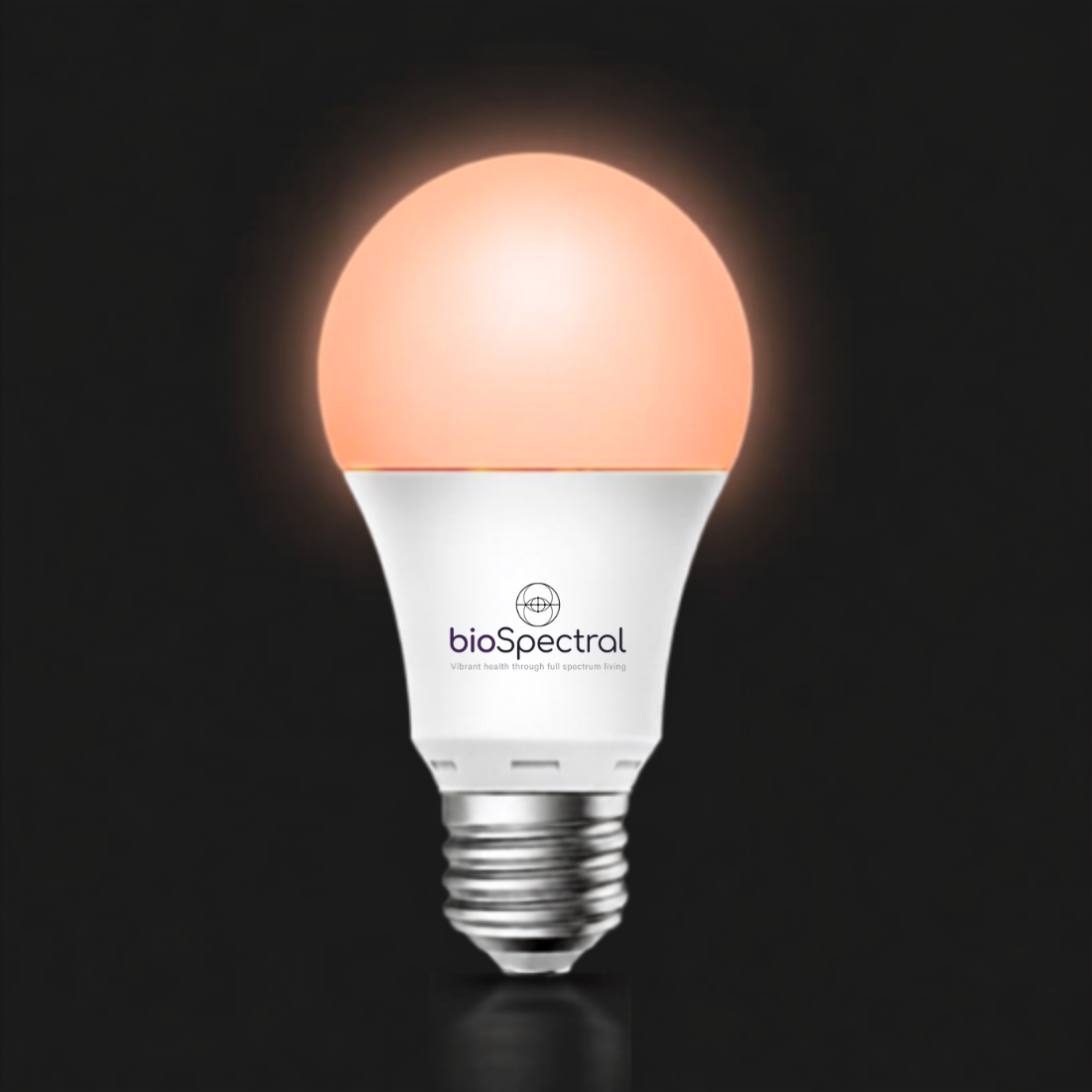
The BioSpectral BioLux Hybrid Bulb
For more than a century, artificial lighting has largely been engineered around one metric: how efficiently can we produce visible light? Biology was rarely part of the equation. That conversation is finally beginning to change.
Dr. Alexander Wunsch recently published The Next Generation of Human Centric Lighting: “Incandescent LEDs” and Their Hidden Health Power, making the case that modern lighting needs to move beyond conventional white LEDs and begin restoring spectral characteristics of the thermal light environments under which human biology evolved. His central thesis overlaps substantially with something we have been working toward for years at BioSpectral Systems: artificial light should be designed around biology, not simply visual brightness and electrical efficiency.
Conventional white LEDs can produce visually bright light while providing an extremely incomplete representation of sunlight. They concentrate their output within the visible spectrum, can contain pronounced short wavelength peaks, and largely eliminate the broad infrared energy naturally accompanying visible light outdoors. Wunsch highlights this problem and describes traditional incandescent light as an electrical source possessing a natural continuous thermal spectrum, rich in infrared and following the blackbody radiation characteristics of thermal emitters such as sunlight and fire.
He further argues that conventional artificial lighting creates an indoor infrared deficit, while red and near infrared wavelengths may contribute important biological effects involving mitochondrial function, circulation, oxidative balance and tissue physiology. We agree strongly with the direction of this thesis. Where we differ is where the spectrum should end, and what a truly biologically aligned light source should actually look like.
An LED designed to resemble incandescent light is still an LED
The emerging concept of the “incandescent LED” is an important improvement over conventional white LED lighting. Modern semiconductor technologies, phosphors and spectral engineering can smooth the visible spectrum, improve color rendering, reduce high energy visible peaks and add selected near infrared wavelengths. Wunsch describes this approach as extending infrared output toward approximately 1,000 nm.
But approximately 1,000 nm is not where sunlight ends. It certainly is not where incandescent light ends. This distinction became one of the fundamental engineering principles behind the BioSpectral BioLux.
Rather than attempting to make an LED imitate an incandescent source, we combined the two technologies. BioLux is a true LED plus incandescent hybrid, combining the precision and efficiency available from modern semiconductor lighting with the continuous broadband infrared emission of a genuine thermal incandescent filament. The best of the new and the best of the old.
This distinction matters. Calling an LED “incandescent” because phosphors or additional semiconductor emitters broaden its spectrum does not turn it into an incandescent thermal emitter. It remains an LED based system engineered to approximate some of the characteristics of incandescent light. It falls well short of a traditional incandescent light spectrum that we have had for over 100 years and thus is not an upgrade from what has already been available on Amazon for $2 a bulb. On the other hand, BioLux physically incorporates incandescent technology, building upon what is already great, ‘the incandescent’ and that allows us at BioSpectral to keep the extended broadband spectrum far beyond any LED based approach can, but also incorporates the ability to change the spectrum throughout the day with precision allowing for unlimited mode selection instead of 3 or 4 mode spectral selection, and incorporates low flicker and low Dirty Electricity EMF design to be the best alternative to sunlight right now.
Why stop at 1,000 nm when nature does not?
Recent work from Professor Glen Jeffery, Professor Robert Fosbury and colleagues provides an important piece of this emerging picture. Their 2025 Scientific Reports paper begins with a profound observation: terrestrial sunlight extends from approximately 300 nm to beyond 3,000 nm, and this spectral environment has been present throughout biological evolution.
Their experiments demonstrated that longer wavelength sunlight can penetrate completely through the human thorax. They then exposed the body to 830 to 860 nm light and observed subsequent improvements in visual function, including when the eyes themselves were shielded. In other words, light striking the body can have biological effects beyond the tissue directly illuminated.
This challenges the simplistic idea that invisible infrared striking the skin is merely wasted energy converted into heat. And this is where I believe Fosbury's emerging work becomes particularly important.
When sunlight is considered in terms of photon flux per unit energy, Fosbury identifies a peak around 0.75 eV, corresponding to approximately 1,650 nm. He then highlights an average activation energy across metabolic reactions of approximately 0.66 eV, corresponding to approximately 1,880 nm. The proximity of those energy scales raises a fascinating question about whether the infrared environment bathing life on Earth is intimately related to the energetic requirements of biological chemistry. It’s our belief based upon first principle thinking tht this broadband IR light above 1,000nm is vitally important for human and animal biology and it will be shown once studied more broadly to be essential for any artificial light source to contain every one of these wavelengths to sustain human health at a well-functioning level.
Fosbury has proposed water as a potentially crucial chromophore within this relationship. The emerging field of aquaphotomics, pioneered by Roumiana Tsenkova, alongside broader work from researchers such as Emilio Del Giudice, Giuliano Preparata and Gerald Pollack, has helped expand the conversation around water as a dynamic, structurally responsive biological medium rather than simply a passive solvent. Spectroscopic research shows that water absorbs strongly and selectively across the infrared, with its hydrogen bonding network and molecular organization responding to changes in its energetic environment. This gives us an important clue as to how biological water may interact with broadband infrared: rather than longer wavelength light simply becoming biologically irrelevant waste heat, absorbed infrared energy can alter molecular vibrations, hydrogen bonding and the conformational organization of water and its surrounding molecular systems. I believe this is one of the most important emerging areas in photobiology and that its biological significance will become increasingly apparent as the field develops.
We are biological water. The human body is predominantly water by mass, and virtually all biological chemistry occurs within an extraordinarily complex aqueous environment. To assume that the enormous infrared component of the natural solar spectrum simply strikes this biological water and becomes irrelevant waste heat as Wunsch seems to say, is, in my view, an increasingly difficult position to defend. Water has highly wavelength dependent absorption throughout the infrared, creating a very plausible and soon to be scientifically obvious physical interface through which this above 1,000nm broadband infrared light energy can influence molecular dynamics, energetic states, protein and membrane environments, mitochondrial function and potentially downstream biochemical processes. Understanding these interactions deserves to sit at the center of the conversation about biologically appropriate lighting.
The direct experimental evidence for specific systemic photobiological benefits is currently strongest across the red and near infrared region, particularly below approximately 1,000 nm, but the scientific frontier increasingly extends beyond this boundary. To lead in biologically optimized lighting, I believe we need to engineer from the emerging science rather than wait decades for every mechanism to become conventional wisdom. Preliminary research is beginning to investigate how longer infrared wavelengths influence subcellular and molecular processes, including mitochondrial signaling, water dynamics and melatonin related pathways. These findings need further replication before specific health outcomes can be claimed, but they provide compelling reasons to investigate the wavelengths that conventional LED lighting almost entirely removes from the indoor environment.
This is precisely why we engineered BioLux differently. An LED only technology that terminates around 1,000 nm recreates only part of the natural electromagnetic environment and, from our perspective, remains biologically incomplete. In that important respect, moving from traditional incandescent lighting to LED only lighting may actually represent a step backward: extraordinary gains in electrical efficiency were achieved partly by eliminating a large broadband infrared component that accompanied artificial light for more than a century. I believe the biological importance of the interaction between these longer infrared wavelengths and biological water will ultimately prove substantial, and we engineered BioLux accordingly rather than waiting for every element of the mechanism to be settled.
If that thesis proves correct, engineering a supposedly human centric light source whose meaningful infrared output terminates around 1,000 nm leaves behind an enormous and potentially biologically important portion of our ancestral electromagnetic environment. Hence every LED currently on the market, including those marketed as ‘incandescent LEDs’ that only contain LED technology.
Nature provides far more than visible light and near infrared
Sunlight reaching us directly contains energy far beyond 1,000 nm. Our natural terrestrial environment extends that infrared exposure further through absorption and thermal re emission from soil, stone, vegetation, buildings and other matter warmed by the sun.
Human beings therefore did not evolve beneath a collection of isolated LED peaks. We evolved immersed in a dynamic broadband electromagnetic environment. Sunlight is broadband. Fire is broadband. Thermal radiation is broadband. Incandescent emission is broadband.
This is why BioSpectral does not view the wavelengths above 1,000 nm as an irrelevant tail on a spectrum graph. We believe they are part of the biological information and energetic environment in which life developed.
That philosophy is reflected directly in BioLux. The current architecture delivers visible light together with enhanced 700 to 3,000 nm broadband infrared, including the continuous spectrum generated by its incandescent component.
Nature does not expose biology to one isolated wavelength, and our philosophy is equally simple: if we are going to bring artificial light indoors, we should preserve as much of the spectral environment found in nature as engineering allows.
Lumens are a human visual metric, not a complete biological metric
For decades, the lighting industry has optimized primarily around what the human eye perceives as brightness and how efficiently electricity can create it. That gave us extraordinary improvements in lumens per watt, but it also encouraged the removal of wavelengths that contribute relatively little to perceived brightness.
Infrared became an inefficiency. From a purely illumination engineering perspective, that makes sense. From a biological perspective, it in our opinion is an enormous conceptual mistake.
A lumen describes visually weighted light output. It does not tell us the complete photon environment reaching the skin, eyes, water, mitochondria and other biological chromophores. It tells us almost nothing about wavelengths outside human visual sensitivity.
Your biology does not experience its electromagnetic environment in lumens.
This is why the Astrophysics/Aquaphotomics thesis’ of Fosbury, Tsenkova, Del Gudice, Pollack, Preparata and others matters so much. When light is considered as photons and electron volts rather than simply visual brightness, an entirely different picture emerges. The approximately 0.75 eV solar photon flux relationship and the approximately 0.66 eV metabolic activation energy relationship sit deep within the infrared region that conventional lighting metrics effectively disregard.
The future of biologically aligned lighting therefore requires us to think beyond lumens and beyond the 1,000nm cutoff of all so called ‘biologically friendly’ LED lights.
BioLux was engineered around the spectrum, not simply what the eye can see
The BioLux architecture delivers full visible spectrum illumination together with enhanced 700 to 3,000 nm broadband infrared. Its incandescent component provides genuine continuous thermal emission rather than attempting to reproduce the entire infrared environment through a handful of semiconductor peaks. This is fundamentally different from simply adding a discrete 850 nm emitter or extending an LED spectrum toward approximately 1,000 nm.
The current BioLux specification also delivers CRI of at least 98 at specified operating temperatures, R9 above 80, a color temperature range from approximately 2700 K down to 1000 K, and luminous output ranging from approximately 330 to 25 lumens.
We have deliberately chosen to optimize multiple dimensions of light simultaneously: visible spectrum quality, color rendering, infrared breadth, circadian timing, intensity, flicker and the electrical environment generated by the bulb itself.
The spectrum should move with time
There is another fundamental problem with many attempts at human centric lighting. Nature does not operate in three preset modes.
Sunlight changes continuously throughout the day. Its intensity changes, its spectral composition changes, and the relationship between visible and infrared energy changes. As evening approaches, the environmental light signal progressively moves toward the warm thermal spectrum associated with sunset and eventually fire.
BioLux was designed around this principle.
Its 1:100,000 dimming ratio allows the bulb to transition continuously from its brighter daytime spectrum toward a dramatically warmer nighttime environment rather than simply jumping between rigid presets. The current BioLux specification spans approximately 2700 K down to 1000 K.
As BioLux is dimmed, more than brightness changes. The spectrum itself changes. Blue disappears first, followed progressively by green, until the nighttime spectrum becomes dominated by red and infrared. At its nighttime end, the BioLux packaging specifies no blue or green light.
That means an ordinary compatible wall dimmer can become a way of continuously changing the biological character of the indoor light environment. There is no need to divide nature into arbitrary blocks of morning mode, afternoon mode, evening mode and nighttime mode. The user can continuously move the spectrum and intensity toward the environment appropriate for that moment.
No WiFi. No Bluetooth. No app required.
Spectrum is only part of the engineering problem
Artificial lighting is electromagnetic technology, so we also looked beyond what comes out of the bulb optically. BioLux has been engineered for ultra low EMI or dirty electricity, with the current specification measuring less than 50 mV peak to peak, alongside less than 5% flicker.
We deliberately use the term ultra low flicker rather than pretending an AC powered lighting product produces mathematically perfect zero modulation. “Flicker free” has become a marketing term used very loosely throughout the lighting industry. What matters to us is measurement, engineering and reducing unwanted modulation as far as practical.
The same philosophy applies to dirty electricity. It is easy to dismiss electrical noise as simply a characteristic of house wiring or the wider electrical environment. Some other brands selling ‘biologically friendly LEDs use this excuse when they don’t understand how to engineer lower dirty electricity within their bulbs. We chose instead to examine what the bulb itself contributes and engineer that contribution downward.
A biologically considered bulb should be evaluated as an entire electromagnetic device. Spectrum matters. Flicker matters. Electrical noise matters. Timing matters. Intensity matters. How those variables change together matters.
Taking the incandescent LED concept to its logical conclusion
Wunsch's work is important because it moves the lighting conversation in the right direction. High CRI matters. Red and near infrared matter. Reducing excessive short wavelength exposure at inappropriate times matters. Flicker matters. Timing matters. Biological compatibility should sit alongside electrical efficiency as an engineering objective.
Where BioSpectral extends that thesis is straightforward: if incandescent light possesses desirable spectral characteristics, why merely make an LED imitate incandescent light when we can incorporate genuine incandescent thermal emission into a modern hybrid architecture?
And if sunlight and our terrestrial environment provide biologically relevant infrared energy well beyond 1,000 nm, why deliberately stop there?
If biological water ultimately proves to be one of the fundamental interfaces through which this longer wavelength energy interacts with life, as I believe Fosbury and others work increasingly points toward, then this distinction becomes even more important.
A light source engineered only around the wavelengths for which we currently have the largest number of photobiomodulation trials risks confusing the limits of today's evidence base with the limits of biology itself.
Nature existed before the randomized controlled trial.
Evolution occurred beneath broadband sunlight, not a laboratory LED array.
Our engineering philosophy therefore starts with nature and then uses emerging science to understand why nature may have built the spectrum the way it did.
This is where human centric lighting needs to go next
BioSpectral Systems takes the emerging human centric lighting philosophy further by combining genuine incandescent thermal emission with modern LED technology.
Instead of creating an LED that attempts to imitate incandescent light, we built a genuine hybrid incorporating incandescent thermal emission. Instead of ending meaningful infrared output around 1,000 nm, BioLux extends broadband infrared through 700 to 3,000 nm. Instead of thinking only about visible brightness, we considered the invisible spectrum as well. Instead of relying solely on rigid daytime and nighttime presets, we engineered continuous spectral change through an enormous dimming range. Instead of calling an AC bulb completely flicker free, we measure and engineer for ultra low flicker. And instead of ignoring the electrical environment created by the electronics inside the bulb, we engineered for ultra low dirty electricity.
BioLux represents our attempt to rethink the light bulb from first principles around human biology.
The question was never simply how efficiently we could illuminate a room. The deeper question was: if human biology developed beneath sunlight, fire, broadband infrared and thermal radiation, what should artificial light actually look like?
I believe the next frontier will be understanding just how important the interaction between broadband infrared and biological water really is. We are biological water walking around beneath a star whose spectrum has bathed life for billions of years. To treat the enormous infrared component of that environment as biologically meaningless simply because our eyes cannot see it or because conventional LEDs do not reproduce it is, in my view, a profound mistake.
As photobiology develops, I believe lighting systems terminating around 1,000 nm will increasingly look incomplete. The wavelengths beyond that boundary, including the region surrounding Fosbury's approximately 0.75 eV solar photon flux relationship and approximately 0.66 eV metabolic activation energy relationship, deserve far more attention.
We did not want to wait for the lighting industry to catch up.
We built BioLux around that future.
BioSpectral BioLux redefining indoor lighting.

References
Alexander Wunsch. The Next Generation of Human Centric Lighting: “Incandescent LEDs” and Their Hidden Health Power. LED Professional Review, 2025.
Glen Jeffery, Robert Fosbury, E. Barrett et al. Longer wavelengths in sunlight pass through the human body and have a systemic impact which improves vision. Scientific Reports, 2025.
Robert Fosbury. Light and Life: A Cosmological Overview. The Guy Foundation, 2025. Discussion of solar photon flux, metabolic activation energies, biological water and the emerging concept of photometabolism.
Muncan, J., & Tsenkova, R. Aquaphotomics—Exploring Water Molecular Systems in Nature. Molecules. 2023;28(6):2630. doi:10.3390/molecules28062630.
Tsenkova, R., & Muncan, J., eds. Aquaphotomics: Exploring Water Molecular Systems in Nature. MDPI Books, 2023. doi:10.3390/books978-3-0365-7119-5.
Tsenkova, R., & Muncan, J. Aquaphotomics for Bio-diagnostics in Dairy: Applications of Near-Infrared Spectroscopy. Springer, 2021.
Muncan, J., & Tsenkova, R. Aquaphotomics—From Innovative Knowledge to Integrative Platform in Science and Technology. Molecules. 2019;24(15):2742.
Kuroki, S., Tsenkova, R., Moyankova, D., et al. Water molecular structure underpins extreme desiccation tolerance of the resurrection plant Haberlea rhodopensis. Scientific Reports. 2019;9:3049.
Del Giudice, E., De Ninno, A., Fleischmann, M., et al. Coherent Quantum Electrodynamics in Living Matter. Electromagnetic Biology and Medicine. 2005;24(3):199–210. doi:10.1080/15368370500379574.
Del Giudice, E., Preparata, G., & Fleischmann, M. QED coherence and electrolyte solutions. Journal of Electroanalytical Chemistry. 2000;482(2):110–116. doi:10.1016/S0022-0728(00)00019-X.
https://www.biorxiv.org/content/10.64898/2026.08.11.744135v1?utm_source=chatgpt.com
https://www.nature.com/articles/s41598-026-35389-6
Related: explore BioLux lighting.




Disclaimer
The information on this site is provided by BioSpectral Systems for educational and informational purposes only. It is not intended to diagnose, treat, cure, or prevent any disease and has not been evaluated by the U.S. Food and Drug Administration or any other regulatory authority. Always consult a qualified healthcare professional before making any changes to your health regimen. By using this site, you acknowledge that you do so at your own discretion and agree that BioSpectral Systems, its affiliates, and contributors are not liable for any outcome resulting from the use of the information presented.
Share:
Fluoride: The Hidden Cost of a More Electronegative World
Cold Face Plunging: A Nervous System Portal