

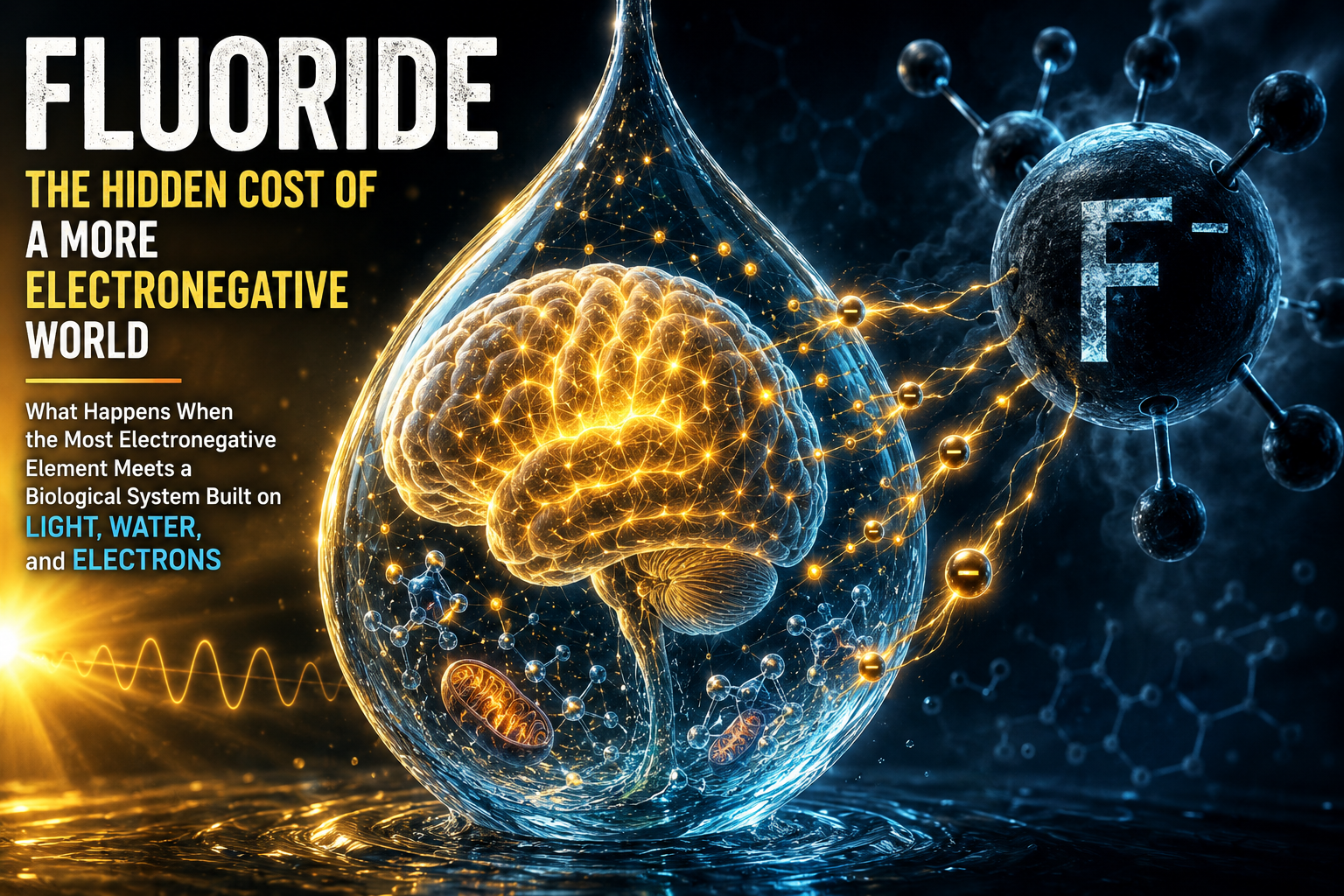
What Happens When the Most Electronegative Element Meets a Biological System Built on Light, Water, and Electrons
Perhaps the most overlooked question surrounding fluoride is not whether it is toxic, but whether it alters the speed and fidelity of biological communication itself. Many enzymes, proteins, and mitochondrial reactions rely upon the movement of protons and electrons through highly organized water networks. Some researchers have proposed that excessive fluoride may disrupt hydrogen bonding and water architecture in ways that slow proton tunneling, one of the fundamental mechanisms used by enzymes to accelerate biochemical reactions. If this hypothesis proves correct, fluoride's impact would extend far beyond individual pathways. It could influence how quickly cells communicate, repair damage, generate energy, recycle proteins, process information, and respond to environmental signals. In this model, the consequence is not simply toxicity. It is a gradual reduction in biological bandwidth. The system becomes slower, less adaptable, less coherent, and less capable of maintaining the high speed electron and proton flows upon which optimal mitochondrial function, cognition, hormone signaling, and regeneration depend.
Executive Summary
Few people think about fluoride beyond their toothpaste, drinking water, or a visit to the dentist. Yet fluoride is not simply another mineral found in nature.
Fluoride is the most electronegative element in the periodic table. In simple terms, it has an extraordinary ability to attract and hold electrons. This matters because life itself is fundamentally an electron story.
Every heartbeat, thought, hormone signal, immune response, and mitochondrial reaction depends upon the movement of electrons through water, proteins, membranes, minerals, oxygen, and light. Health is not merely chemistry. Health is the organized movement of energy through a living system. The question is therefore not whether fluoride exists in nature. It does.
The question is what happens when increasing amounts of the most electronegative element on Earth are introduced into a biological system built upon light, water, electrons, circadian timing, and mitochondrial energy production. As modern medicine, pharmaceuticals, water purification, governmenting bodies and many other private organizations are slipping luoride into water, food and other products that are being ingested by you, your family, your children, your grndparents and your friends and animals.
For decades the fluoride discussion has largely focused on teeth. Today, a growing body of scientific literature is asking much larger questions. Questions surrounding thyroid function. Questions surrounding neurodevelopment. Questions surrounding IQ. Questions surrounding pregnancy. Questions surrounding mitochondrial health. Questions surrounding the cumulative impact of fluoride based chemicals now found throughout modern life.
This article explores both the established science and the emerging biophysical questions that deserve further investigation.
The Modern Fluoride Story
Fluoride is not new. Fluoride has existed naturally in rocks, groundwater, oceans, soils, and living systems for millennia. What is new is the scale of exposure. Today fluoride exposure extends far beyond drinking water.
It can be found in:
• Fluoridated water supplies
• Toothpaste
• Mouthwashes
• Certain pharmaceuticals
• Pesticides
• Industrial chemicals
• Non stick cookware
• PFAS compounds
• Food packaging
• Cleaning products
• Personal care products
• Certain anesthetics such as halothane and isoflurane
The modern human is exposed to fluorinated compounds from more sources than at any other time in history. This matters because fluoride is not biologically neutral. Unlike nutrients that support biological function, fluoride has no known essential role in human physiology. No fluoride deficiency disease has ever been identified. No biological system requires fluoride for optimal function. Its proposed benefits have historically centered almost entirely on dental health. The question therefore becomes: What are the long term biological trade offs?
The Most Electronegative Element On Earth
Electronegativity describes an atom's ability to attract electrons. Fluorine sits at the very top of the periodic table in this regard. No other element pulls electrons more aggressively. From a biophysical perspective this is fascinating. Life depends upon the movement of electrons.
• Photosynthesis moves electrons.
• Mitochondria move electrons.
• Nervous systems move electrons.
• The electron transport chain exists because electrons move.
• Every redox reaction within the body depends upon electron movement.
When discussing fluoride, one of the key hypotheses explored by researchers interested in biophysics is whether excessive fluoride exposure may interfere with the flow of electrons through biological systems. From first principle thinking this is obvious. The body is a living matrix of water and DC electricity and anything that changes the electrical or magnetic or photonic or acoustic properties of the body’s water will change the movement of energy within the system. The fluoride question is above energy not just chemistry.
The IQ Question We Can No Longer Ignore
For years, concerns surrounding fluoride and intelligence were dismissed as fringe science. That is becoming increasingly difficult to justify.
In 2025, researchers published one of the most comprehensive analyses ever conducted on fluoride exposure and cognitive development. The systematic review and meta analysis published in JAMA Pediatrics evaluated 74 studies examining fluoride exposure and IQ outcomes in children. The findings were significant.
Among studies that measured urinary fluoride, which reflects total fluoride exposure from all sources, every 1 mg/L increase in urinary fluoride was associated with a 1.63 point reduction in IQ. Even when researchers restricted analysis to studies judged to have lower risk of bias, an inverse association remained.
The effect size became smaller but persisted. Importantly, the authors concluded that evidence across the literature generally supported an inverse relationship between fluoride exposure and children's IQ scores.
This does not mean every child exposed to fluoride will experience cognitive impairment. Nor does it mean fluoride is the sole driver of neurodevelopmental disorders. What it does mean is that the long standing assumption that fluoride exposure is biologically inconsequential can no longer be maintained. The developing brain appears to be particularly sensitive to fluoride exposure. That fact alone warrants serious scientific attention.
Why The Developing Brain May Be Vulnerable
The human brain is one of the most energy demanding organs ever produced by evolution. Although representing only a small percentage of total body weight, it consumes roughly twenty percent of resting energy production.
Brain development depends upon:
• Mitochondrial function
• Thyroid hormones
• DHA
• Oxygen delivery
• Water structure
• Redox signaling
• Circadian timing
• Cellular communication
Any environmental factor capable of disrupting these systems has the potential to influence neurodevelopment. This is why researchers increasingly view fluoride through the lens of developmental biology rather than dentistry alone. The concern is not merely fluoride exposure in adulthood. The concern is exposure during pregnancy, infancy, and childhood, when neural circuits are still forming. During these periods even subtle disruptions can have lifelong consequences.
Fluoride And The Thyroid
The thyroid may be one of the most overlooked pieces of the fluoride puzzle. The thyroid gland relies heavily upon iodine. Iodine is essential for the production of thyroid hormones. Without sufficient iodine, metabolism slows, energy production falls, and neurological development suffers.
Fluoride belongs to the same halogen family as iodine. From a biochemical perspective, halogens often compete with one another. Researchers have therefore questioned whether excessive fluoride exposure may interfere with iodine utilization and thyroid function. I know they absolutely do. Multiple studies have reported associations between fluoride exposure and altered thyroid hormone levels. In the mainstream, the relationship remains complex and is influenced by iodine status, overall nutrition, and environmental context. It’s obvious from first principle thinking that fluoride may contribute to thyroid dysfunction and deserves far greater attention than it currently receives.
This is particularly relevant given the widespread prevalence of suboptimal iodine intake throughout many modern populations. If iodine is already marginal, additional competition from fluoride may become more biologically significant. The writing is on the wall…
Fluoride is not just competing with iodine in the thyroid. It may be competing with iodine in the brain, choroid plexus, cerebrospinal fluid, breasts, and other tissues specifically designed to concentrate iodine. If iodine is a critical component of how humans convert environmental information into biological signals, then chronic fluoride exposure may represent an information problem as much as a toxicology problem.
Fluoride And The Rise Of Fluorinated Chemicals
Perhaps the biggest fluoride story has nothing to do with drinking water. It may be the explosion of fluorinated chemicals. The modern world is saturated with fluorine chemistry.
PFAS compounds, often referred to as "forever chemicals," have become one of the largest environmental contamination issues in human history. These compounds are extraordinarily stable because of the carbon fluorine bond, one of the strongest bonds in chemistry.
That same stability makes them difficult to break down. As a result they accumulate. In water. In soil. In wildlife. In food chains. And increasingly, in human tissues. The story of attorney Robert Bilott and the legal battle against DuPont helped expose the scale of this problem. His work revealed decades of environmental contamination involving fluorinated compounds and raised broader questions about the long term consequences of introducing highly persistent synthetic chemicals into biological systems.
Fluoride itself and PFAS are not identical substances. However, they belong to the same broader fluorine chemistry story. A story that deserves much greater public awareness.
The modern fluoride discussion cannot be separated from the larger question: What happens when biological systems evolved under natural conditions are increasingly immersed in synthetic fluorinated environments?
The Bigger Question Mainstream Struggles With
The conventional fluoride debate often asks: Does fluoride reduce cavities? That may be the wrong question.
The more important question may be: What are the biological consequences of increasing exposure to one of the most electronegative substances known to science?
As researchers continue investigating fluoride's effects on neurodevelopment, thyroid biology, and human physiology, a deeper framework begins to emerge.
One that extends beyond toxicology. One that includes light. Water. Mitochondria. Redox biology. Circadian timing. And the movement of electrons through living systems.
A Biophysical Interpretation of Fluoride, Water, Mitochondria, Redox, and Human Signaling: Beyond Toxicology
What if fluoride's greatest impact is not simply chemical? What if it is electrical? What if the deeper story is not about toxicity alone, but about how fluoride interacts with a biological system built upon light, water, electrons, magnetism, and timing?
Many of the concepts discussed below are hypotheses informed by my own observations and synthesis of the work of researchers such as Dr. Gerald Pollack, Dr. Gilbert Ling, Dr. Douglas Wallace, Nick Lane, Roeland van Wijk, and Dr. Jack Kruse. They may offer a useful framework for understanding why fluoride appears capable of influencing systems that extend far beyond teeth.
Health Is An Electron Story
Modern medicine is built largely upon chemistry. Biophysics begins one level deeper. Before chemistry there is energy. Before molecules react, electrons move. Before hormones signal, electrons move. Before neurons fire, electrons move. Before mitochondria make ATP, electrons move.
Life is fundamentally an electron transfer system. The body takes photons from sunlight, electrons from food, minerals from the Earth, oxygen from the atmosphere, and water from the environment, then organizes them into a coherent living network.
When electrons move efficiently, biology works. When electron flow becomes disrupted, biology becomes increasingly chaotic. This is where fluoride becomes interesting. Fluoride is the most electronegative element in the periodic table. Its defining characteristic is its ability to attract and hold electrons.
From a purely biophysical perspective, that raises an important question: What happens when a substance exceptionally good at attracting electrons accumulates within a system dependent upon electron movement?
Water: The Forgotten Battery
Most discussions about fluoride focus on teeth. Few discussions focus on water. Yet the human body is approximately 60 percent water as an aduilt and 85% as a baby by weight. The brain is roughly 75 percent water. The eye is over 95 percent water. The cerebrospinal fluid surrounding the brain and spinal cord is 99% water.
Every protein, membrane, enzyme, and mitochondrial reaction depends upon water. According to the work of Dr. Gerald Pollack, water may function as more than a simple solvent. Water may also function as an energy storage medium. Pollack's work demonstrated that light, particularly ultraviolet and infrared wavelengths, can organize water into structured regions known as exclusion zones. These exclusion zones carry electrical charge. In this framework, sunlight is not merely illuminating the body. Sunlight is charging the body's biological battery.
This is where fluoride enters the discussion. My hypothesis is that fluoride may impair the ability of water to organize and store charge efficiently. If true, the implications extend far beyond dental health. The question would become: How does fluoride influence the body's ability to store and distribute energy?
The Dielectric Story
A dielectric is a material capable of storing electrical charge. The higher the dielectric constant, the greater the ability to store energy. In nature, water possesses an extraordinarily high dielectric constant.This is one reason water is so central to life.
According to the biophysical model, sunlight increases the energy storing capacity of water by expanding structured water domains. Fluoride may do the opposite. Several researchers have proposed that fluoride disrupts hydrogen bonding networks within water. If this occurs at biologically meaningful levels, it could potentially influence charge storage, cellular communication, mitochondrial efficiency, and signal fidelity. And it’s my opinion that this is the case and the implications are massive! Remember, every biological process depends upon water behaving correctly.
Fluoride, Mitochondria, And Redox
Mitochondria are of two types some with cristae and some without, they produce ROS/RNS, biophotons, steroid homrones, are key in RBC production, make ATP to unforld proteins, signal the nucleus, synthesize energy, deuterium depleted water, and carbondyoxide which allows us to breathe. But they are also timing engines. They convert environmental information into biological action.
Every second, mitochondria move electrons through the electron transport chain. This movement generates voltage. Voltage generates magnetic fields. Magnetic fields influence biology. Life depends upon maintaining this flow.
The biophysical concern surrounding fluoride is not merely whether it is toxic. The concern is whether fluoride interferes with the conditions required for optimal electron transfer. A decline in electron flow produces what we call a decline in redox potential. Redox is best thought of as the ability to move and manage electrons. High redox equals adaptability. Low redox equals vulnerability.
If fluoride contributes to reductions in redox potential, even subtly, the consequences may appear throughout the body.
• Poor recovery.
• Brain fog.
• Hormonal dysfunction.
• Sleep disruption.
• Reduced resilience.
• Impaired mitochondrial signaling.
In this framework, fluoride is not merely a toxin. It becomes a potential disruptor of biological energy transfer.
The Iodine Connection
Few nutrients are more important to this discussion than iodine.
Iodine plays critical roles in:
• Thyroid function
• Brain development
• Breast tissue
• Cerebrospinal fluid production
• Hormonal regulation
• Antioxidant defense
• Light responsive biology
Humans actively concentrate iodine in specific tissues.
• The thyroid.
• The choroid plexus.
• The breasts.
• The gastric system.
These tissues appear to have evolved mechanisms specifically designed to accumulate iodine. Why? My hypothesis is that iodine plays a larger role in biological signaling than current models recognize. Iodine appears uniquely positioned to support tissues responsible for communication, timing, and environmental sensing. Fluoride belongs to the same halogen family. When fluoride exposure rises while iodine intake falls, biological competition emerges.
This is particularly concerning given that modern populations generally consume less seafood, shellfish, and iodine rich foods than many ancestral populations. The result may be a biological environment increasingly dominated by fluorinated chemistry while simultaneously becoming deficient in iodine. Huge implications for the above tissues, organs and the electrical capacity of the water they contain.
DHA, Light, And Semiconduction
One of the most fascinating areas of emerging biophysics involves DHA. DHA is not merely a fat. DHA is concentrated in the retina, brain, nervous system, and reproductive tissues. These are the most information intensive tissues in the body. Researchers such as Dr. Michael Crawford have highlighted DHA's unique role in neural evolution. The hypothesis advanced by several biophysical researchers is that DHA may function as part of a biological semiconductive network.
In simple terms, DHA may help convert environmental information into biological signals. If this model is correct, anything that interferes with electron flow could influence signaling quality. This leads to an intriguing question: Could fluoride influence the efficiency of these biological communication networks? Mainstream are yet to ask this question because they are afraid of the answer they will likely find.
Fluoride And The Choroid Plexus
The choroid plexus is one of the most underappreciated structures in the human body.
• It produces cerebrospinal fluid.
• It regulates the chemical environment of the brain.
• It contains high concentrations of iodine transport mechanisms.
• It sits at the intersection of water, brain function, circadian biology, and neurodevelopment.
The hypothesis explored by several researchers is that disruption of iodine concentration within the choroid plexus may influence cerebrospinal fluid dynamics and neural signaling.
If fluoride competes with iodine in this system, which I believe it does the implications most likely are profound! On first principle thinking this makes sense. It also aligns with the broader observation that fluoride appears capable of influencing neurodevelopmental outcomes.
Fluoride, Melatonin, And Circadian Timing and The Pineal Gland
Circadian biology is fundamentally a timing system. Every cell in the body follows a rhythm. Every hormone follows a rhythm. Every mitochondrial process follows a rhythm. Melatonin is one of the master regulators of this timing network. Several researchers have proposed that fluoride accumulation may influence pineal gland biology. While this remains debated, it raises an important question. What happens when environmental chemicals interfere with the body's timing systems?
From a biophysical perspective, poor timing eventually becomes poor energy production. Poor energy production eventually becomes disease. The modern epidemic of circadian dysfunction may therefore involve far more than artificial light alone. It involves environmental chemicals capable of influencing biological timing networks like fluoride and glyphosate.
From a conventional perspective, the pineal gland is best known for producing melatonin and helping regulate circadian rhythms. From a biophysical perspective, however, the pineal may be viewed as a timing organ that sits at the intersection of light, water, cerebrospinal fluid, magnetism, and mitochondrial signaling. My hypothesis is that fluoride's potential impact on the pineal gland extends beyond simple calcification. Because fluoride is highly electronegative, it may influence the structured water, mineral balance, and electron dynamics that help govern the pineal's ability to accurately interpret environmental light and darkness signals. The pineal operates within a highly hydrated environment surrounded by cerebrospinal fluid, a medium that carries information throughout the central nervous system. If fluoride alters hydrogen bonding networks, iodine availability, charge separation, or water organization within this environment, it may contribute to reduced signaling fidelity between the retina, suprachiasmatic nucleus, and pineal gland. The consequence would not simply be lower melatonin production. It could represent a broader disruption of biological timing itself. In this framework, the pineal gland acts less like a hormone factory and more like a biological clock synchronizing the body to the solar day. Anything that impairs its ability to sense, process, and relay environmental information may gradually reduce circadian precision, sleep quality, mitochondrial repair, hormonal coordination, and ultimately the body's ability to convert energy into coherent biological time.
PFAS And The Fluorinated Planet
The fluoride discussion does not stop with water. We now live on an increasingly fluorinated planet. PFAS compounds have been detected in drinking water, wildlife, rainfall, food chains, blood, breast milk, and human tissues. These compounds persist because fluorine forms extraordinarily stable chemical bonds. The question facing modern humanity is simple.
What are the long-term consequences of introducing fluorinated chemistry into nearly every aspect of the environment? Slowed growth, reduced dielectric constant in all living systems… the implications could be vast!
The BioSpectral Perspective
At BioSpectral Systems we view health through a biophysical lens.
Light matters.
Water matters.
Mitochondria matter.
Circadian biology matters.
Magnetism matters.
Redox matters.
Energy matters.
When these systems are functioning properly, biology tends to organize itself toward health.
When these systems become disrupted, biology tends to drift toward dysfunction.
Fluoride is one of many environmental variables capable of influencing this equation.
Not because it is the sole cause of disease. But high exposures can be catastrophic, because life itself depends upon the precise movement of electrons through water, proteins, membranes, and mitochondria. Anything capable of altering that flow deserves our attention.
Practical Considerations
While the science continues to evolve, several common sense strategies may help reduce unnecessary fluoride burden:
• Filter drinking water appropriately.
• Avoid unnecessary fluorinated products.
• Prioritize seafood and shellfish rich in iodine.
• Optimize sunlight exposure.
• Support circadian biology.
• Maintain strong mitochondrial health.
• Avoid non stick cookware where practical.
• Reduce exposure to PFAS containing products.
• Prioritize hydration and mineral balance.
• Spend more time in natural environments.
These interventions support health and minimize fluoride exposure.
The Bigger Question
The deeper lesson may not be about fluoride alone. It may be about how we think about health. Modern biology is increasingly discovering that life is not merely chemistry. Life is organized energy.
· Light is information.
· Water is a battery.
· Mitochondria are timing engines.
· The nervous system is an electrical network.
The body is a dynamic interaction between photons, electrons, protons, water, minerals, oxygen, and time. Viewed through that lens, fluoride becomes more than a dental discussion. It becomes a key substance we cannot let too much enter our living water matrix as a biological system likely cannot thrive when fluoride builds up in a biological system.
References
· Taylor, K. W., Eftim, S. E., Sibrizzi, C. A., et al. (2025). Fluoride Exposure and Children's IQ Scores: A Systematic Review and Meta Analysis. JAMA Pediatrics.
· Veneri, F., Vinceti, M., Generali, L., et al. (2023). Fluoride Exposure and Cognitive Neurodevelopment: Systematic Review and Dose Response Meta Analysis. Environmental Research.
· Pollack, G. H. The Fourth Phase of Water.
· Ling, G. N. Life at the Cell and Below Cell Level.
· Wallace, D. C. Mitochondrial and bioenergetic research.
· Lane, N. The Vital Question.
· van Wijk, R. Light in Shaping Life.
· Bilott, R. The Lawyer Who Became DuPont's Worst Nightmare.
https://www.nytimes.com/2016/01/10/magazine/the-lawyer-who-became-duponts-worst-nightmare.html
· Horvath, J. NAD precursor discussions:
https://www.rapamycin.news/t/nad-precursors-save-your-money-folks/2467
· https://youtu.be/_kezGvY5bN8
Disclaimer
This article contains both established scientific findings and biophysical hypotheses. Where evidence is well established, peer reviewed literature is cited. Where mechanisms remain theoretical or are part of an emerging biophysical framework, they are presented as hypotheses designed to stimulate discussion and further investigation.






Disclaimer
The information on this site is provided by BioSpectral Systems for educational and informational purposes only. It is not intended to diagnose, treat, cure, or prevent any disease and has not been evaluated by the U.S. Food and Drug Administration or any other regulatory authority. Always consult a qualified healthcare professional before making any changes to your health regimen. By using this site, you acknowledge that you do so at your own discretion and agree that BioSpectral Systems, its affiliates, and contributors are not liable for any outcome resulting from the use of the information presented.
Share:
Redox Of Human Civilization: Where Energy Becomes Time