

Most blue-blocker reviews can only tell you half the story, because most of them never test past the edge of visible light. A spectrometer that stops at 780nm can tell you how much blue light a lens blocks. It can't tell you what's happening to the light on the other side of the spectrum — the red and near-infrared wavelengths your eyes are exposed to just as constantly, from sunsets, candlelight, incandescent bulbs, and fireplaces, and which your retina's mitochondria actually use.
That's the gap we wanted closed before saying anything public about how our lenses perform. So we didn't write our own numbers — we had an independent party test the actual product and publish the result.
Independent testing, run to 950nm
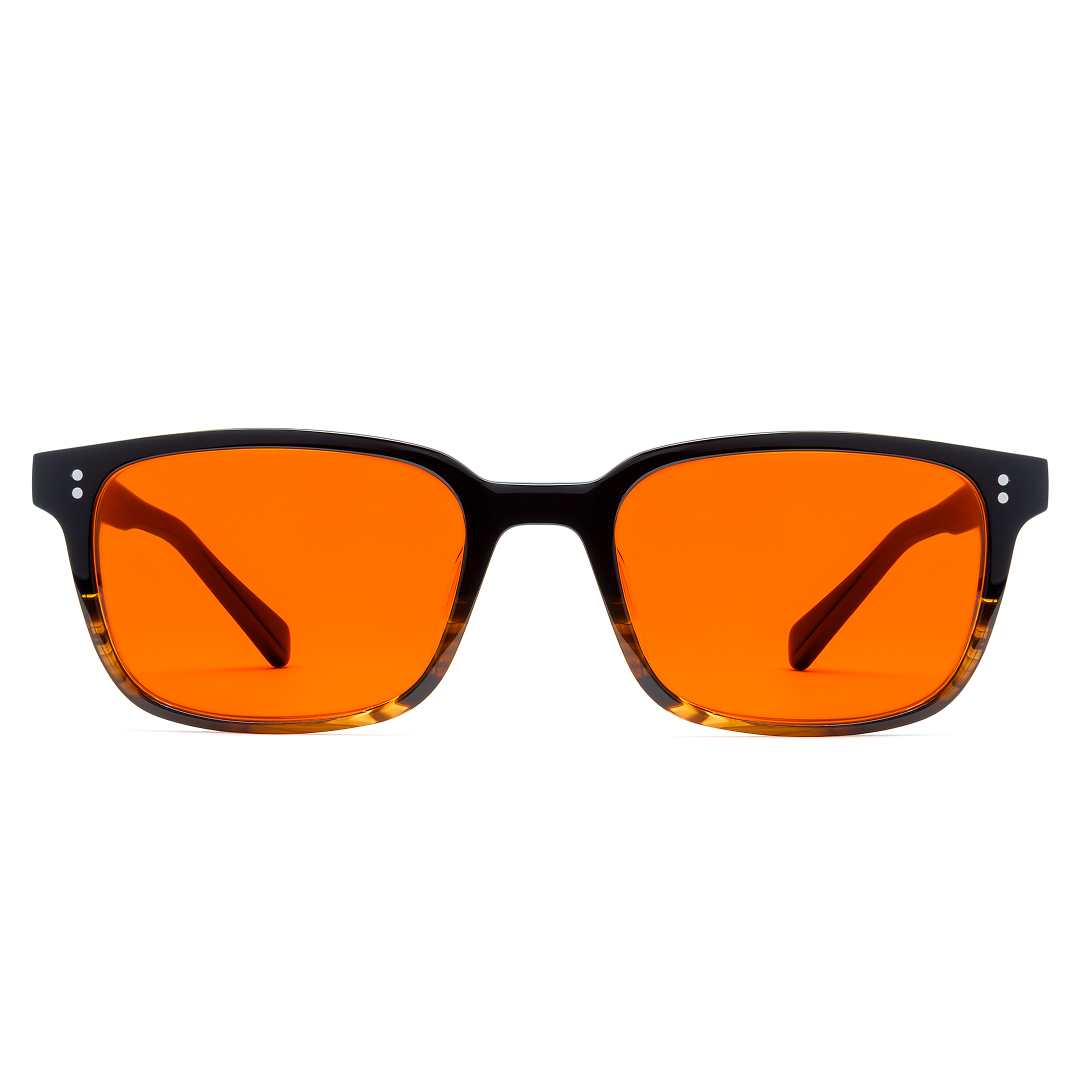
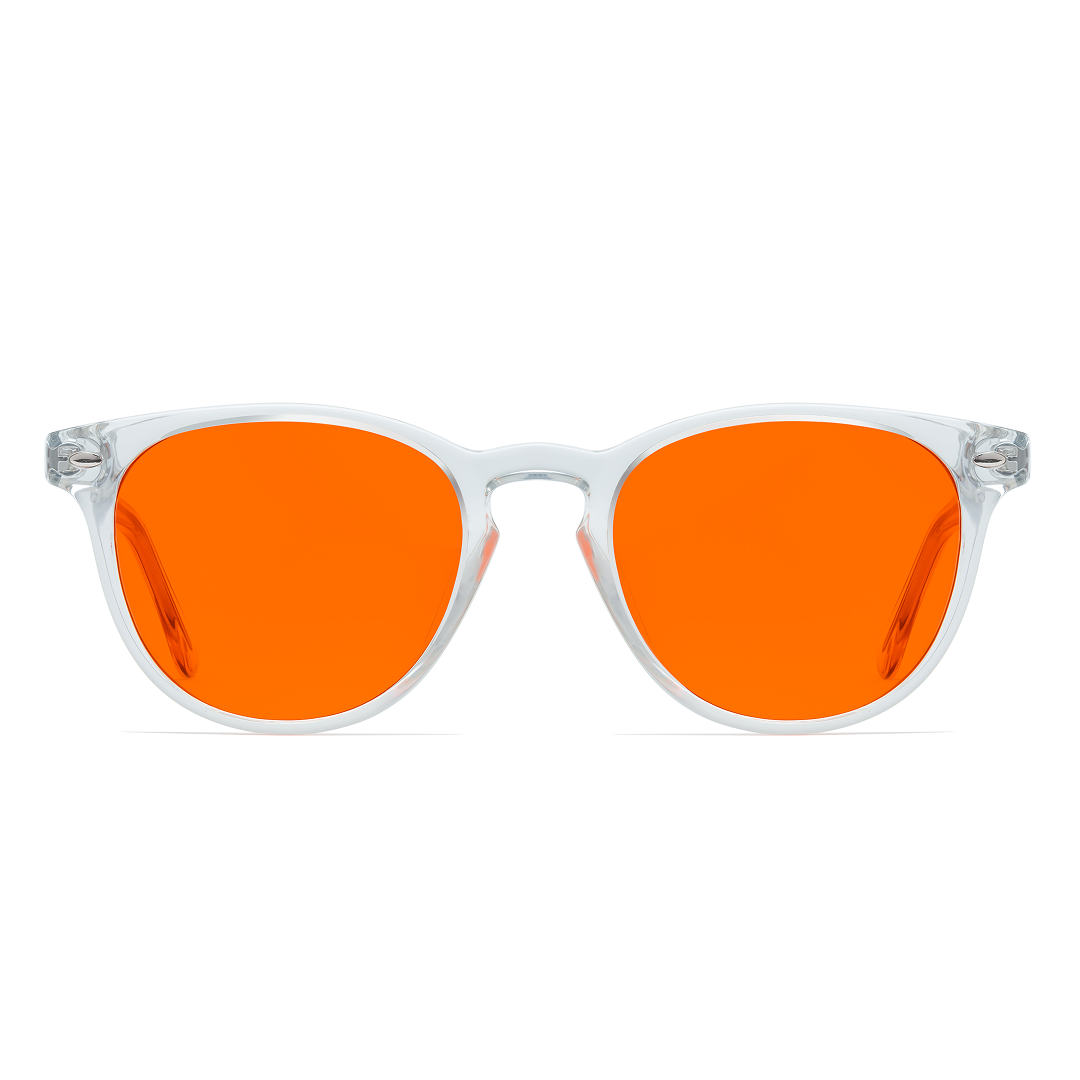
Optimize Your Biology ran spectrometer transmission readings on our Night and Day lenses across 350–950nm, alongside seven other blue-blocking brands on the market, and published the full data set publicly. Two things mattered to us in that test: how much melanopic (sleep-disrupting blue) light a lens actually blocks, and — because almost nobody else measures this — how much of the red and near-infrared band it still lets through.
Our Night lens blocked 99% of melanopic light. That ties or leads the field. But it also passed 94% of red and near-infrared light through — the highest of every lens OYB tested, ahead of DefenderShield, Chroma, EMR-TEK, BlockBlueLight, Roka, TrueDark, and Vivarays.
Melanopic (sleep-disrupting) light blocked — Night lens
Source: Optimize Your Biology, spectrometer transmission testing, 350–950nm.
Red + near-infrared light passed through — Night lens
Source: Optimize Your Biology, spectrometer transmission testing, 350–950nm.
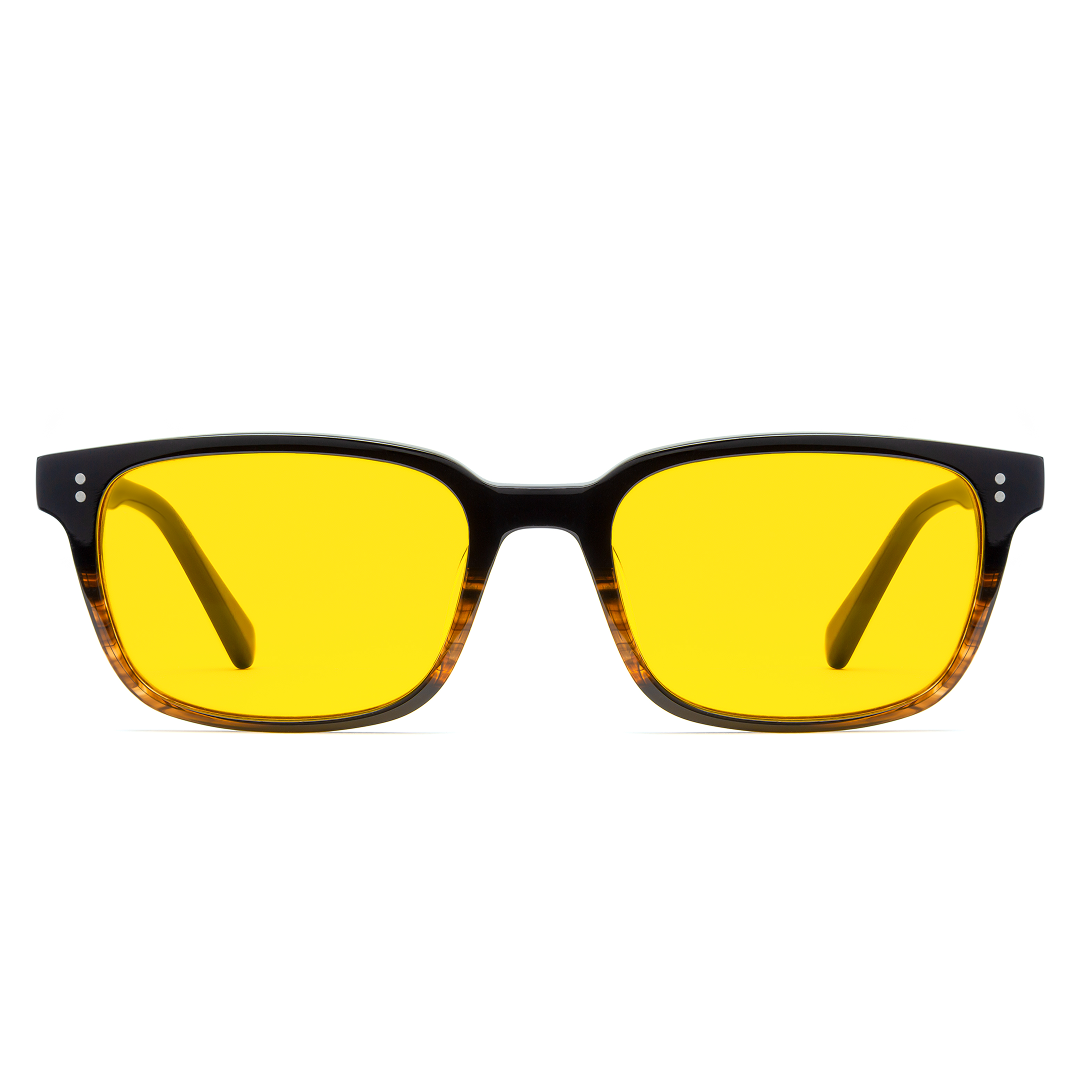
Our Day lens blocks 97% of blue light overall — the headline number on the daytime side.
Day lens — blue light blocked
Source: Optimize Your Biology, spectrometer transmission testing, 350–950nm.
It also blocked 71% of melanopic (sleep-disrupting) light specifically, ahead of every clear/light-tint competitor OYB tested — TrueDark (59%), EMR-TEK (53%), and Vivarays (33%) — while staying the clearest of the group at 80% visible-light transmission.
Melanopic (sleep-disrupting) light blocked — Day lens
Source: Optimize Your Biology, spectrometer transmission testing, 350–950nm.
View the full data as a table
| Night lens | Melanopic blocked | Red + NIR passed | Clarity (VLT) |
|---|---|---|---|
| BioSpectral Night | 99% | 94% | 26% |
| Vivarays Nighttime | 99% | 83% | 15% |
| Roka Wind Down | 99% | 88% | 23% |
| EMR-TEK Red | 99% | 90% | 14% |
| TrueDark Twilights | 99% | 86% | 7% |
| Chroma Nightshades | 98% | 91% | 24% |
| BlockBlueLight NightFall | 98% | 90% | 38% |
| DefenderShield Orange 99 | 94% | 92% | 44% |
| Day lens | Melanopic blocked | Clarity (VLT) |
|---|---|---|
| BioSpectral Day | 71% | 80% |
| TrueDark Daytime | 59% | — |
| EMR-TEK Clear | 53% | — |
| Vivarays Daytime | 33% | — |
Why we think passing red and near-infrared light matters
The easy way to block more blue light is to block more of everything — tint the lens darker and darker until almost nothing gets through. That's part of why some of the lenses in that test show such low visible-light clarity. But your retina isn't just a blue-light sensor. It's also the most metabolically active tissue in your body, packed with mitochondria that keep demanding ATP whether it's day or night.
A UCL research group led by Glen Jeffery has published a consistent line of work on this over the past decade. According to PubMed, their 2014 paper found that 670nm near-infrared exposure increased ATP production and reduced oxidative stress markers in aged retinal tissue (Gkotsi et al., 2014). A 2016 follow-up used real-time optical monitoring to show the same 670nm exposure measurably increased the redox state of retinal mitochondria in vivo (Kaynezhad et al., 2016). And a 2017 study tied that mitochondrial correction to actual function, recording roughly 25% improvement in retinal electrical response (ERG a-wave and b-wave) in aged mice after a month of daily 670nm exposure (Sivapathasuntharam et al., 2017).
These are animal and in-vivo tissue studies, not a clinical trial in humans wearing blue-blocking glasses — we're not going to overstate what they show. What they do show, consistently, across three separate papers from the same lab, is that near-infrared light isn't just inert background radiation your retina tolerates. It appears to be a signal its mitochondria actually use. If that's the case, a lens that blocks the light disrupting your sleep while still passing through the light your retinal mitochondria rely on is doing something meaningfully different than a lens that just blocks everything indiscriminately.
Where this leaves the comparison
We're not claiming to be the only pair of blue-blocking glasses worth buying, and this isn't the only test that matters. But on the one independent, published, apples-to-apples comparison we have in front of us — melanopic blocking and NIR transmission, measured the same way across eight brands — our Night lens came out blocking as much or more sleep-disrupting light as anything else tested, while passing more red and near-infrared light through than all seven competitors. That's the trade-off we designed for, and it's the first time we've had a third party confirm we actually hit it.
If you want to see the full spectrum breakdown and how we read it, I walked through it on video here. And if you're deciding between our Night and Day lenses for your own setup, the Night lens product page and Day lens product page both have the current spec sheets.



Disclaimer
The information on this site is provided by BioSpectral Systems for educational and informational purposes only. It is not intended to diagnose, treat, cure, or prevent any disease and has not been evaluated by the U.S. Food and Drug Administration or any other regulatory authority. Always consult a qualified healthcare professional before making any changes to your health regimen. By using this site, you acknowledge that you do so at your own discretion and agree that BioSpectral Systems, its affiliates, and contributors are not liable for any outcome resulting from the use of the information presented.
Share:
Green Light Therapy for Migraines: Natural Migraine Relief, Light Biology and What the Research Shows