

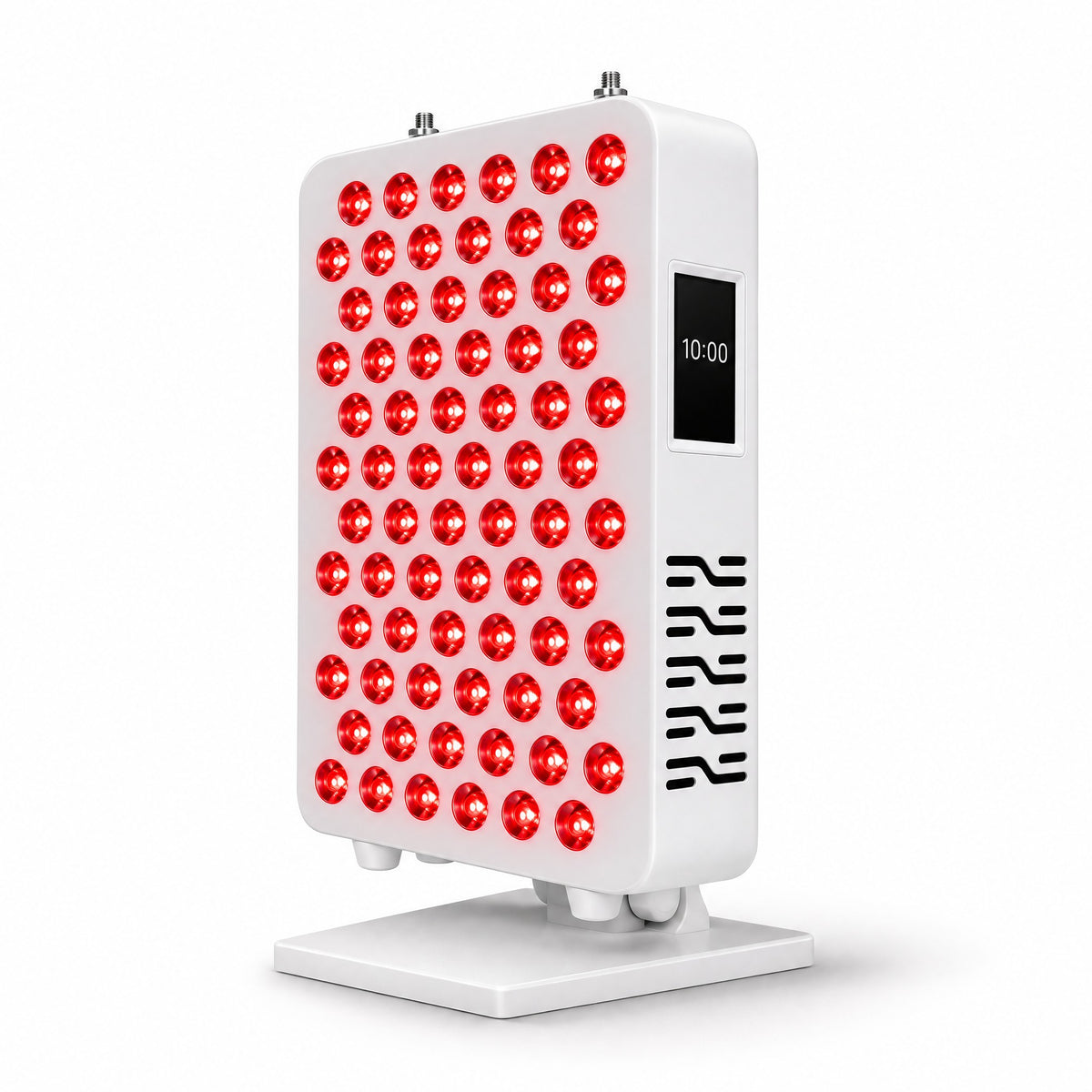
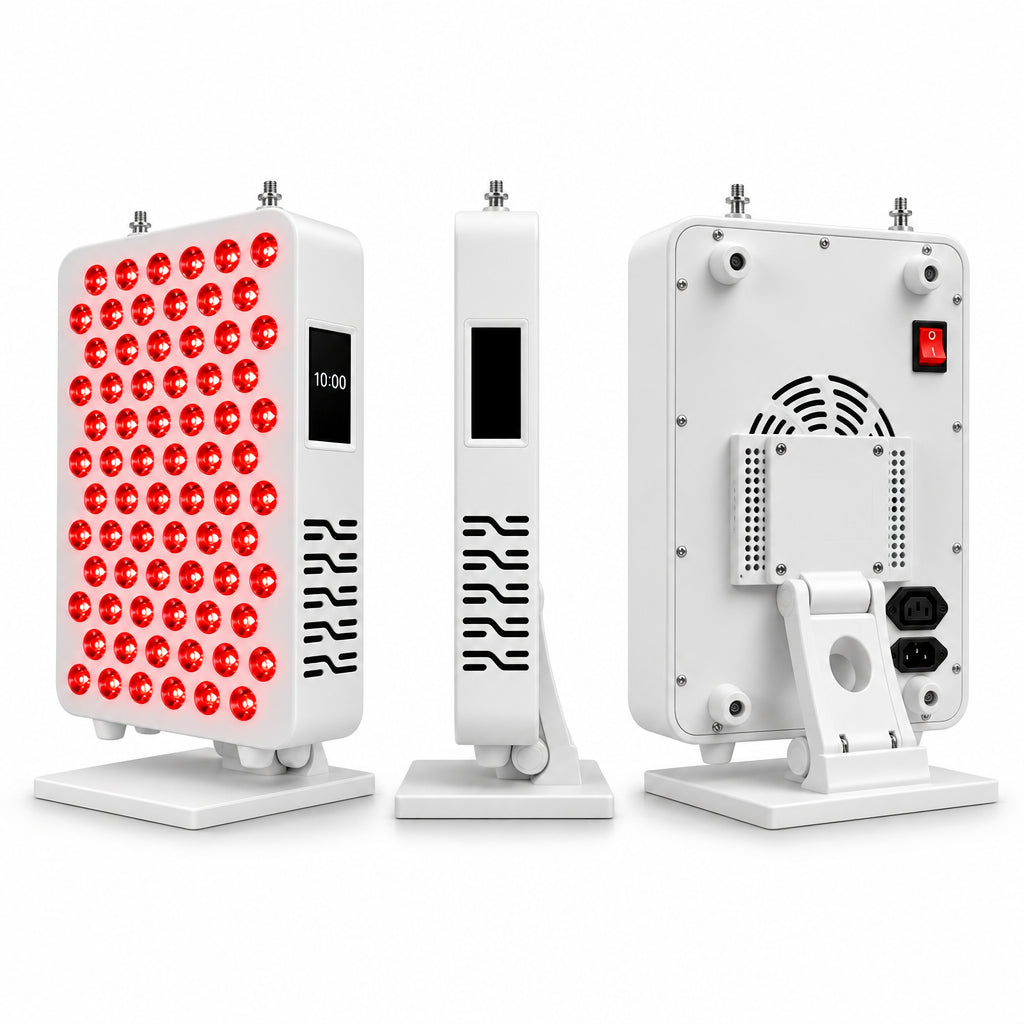
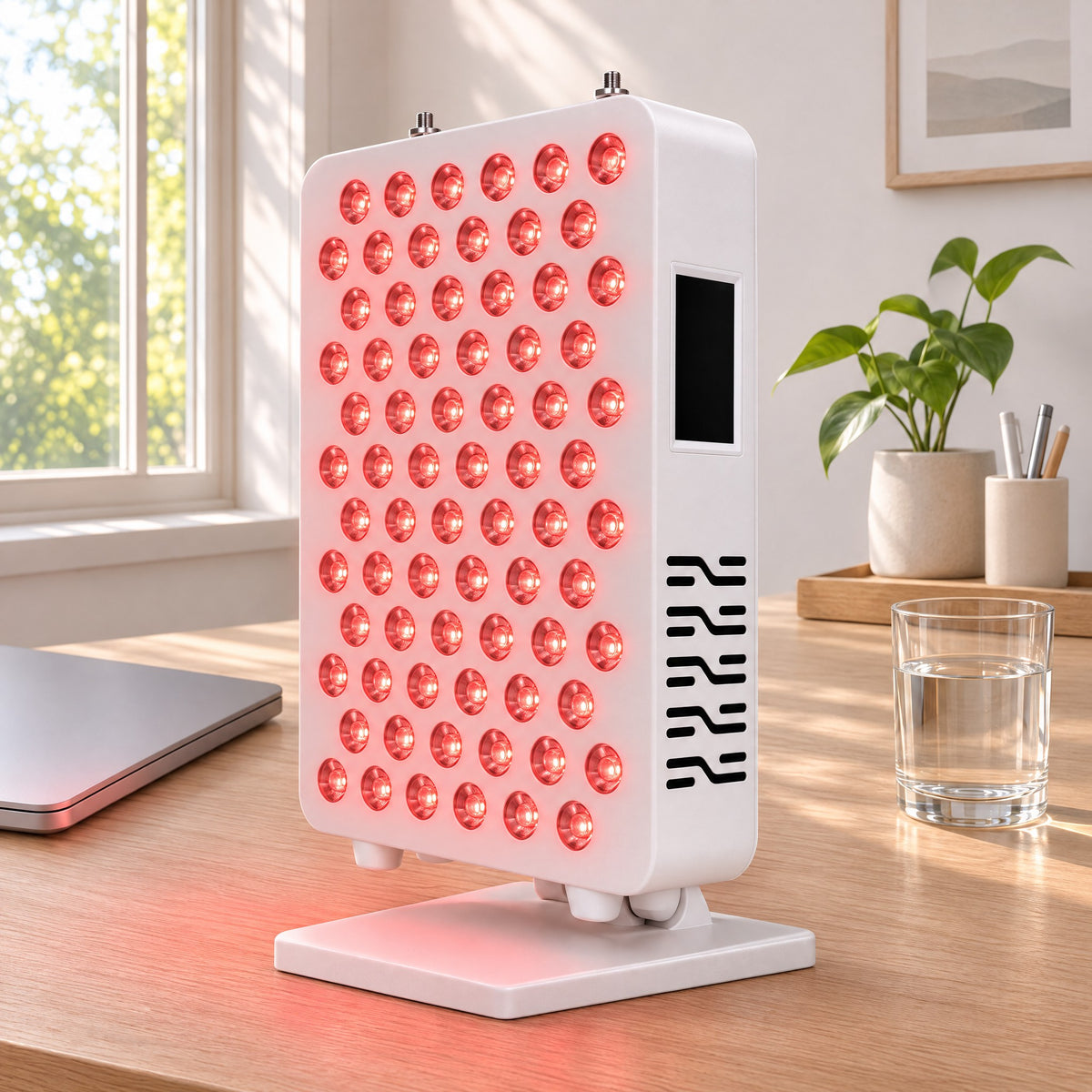


BioSpectral Red + Near-Infrared PBM Panel (72 LED)
The BioSpectral Red + Near-Infrared PBM Panel (72 LED) brings 8 targeted wavelengths of red and near-infrared light into a compact tabletop panel, one of the widest red and near-infrared spectrums available.
- 8 wavelengths: 630, 650, 660, 670, 810, 830, 850 and 1060 nm
- 72 dual-chip LEDs: about 70 mW/cm² true irradiance at 6 inches, laser power meter scale (145 mW/cm² on a solar power meter)
- Low EMF design: a shielding lining blocks electric fields, plus a low-EMF power supply
- No wireless: no Bluetooth, no app, no wireless remote
- Touchscreen: timer up to 60 minutes for a focused session or background lighting, plus brightness and optional pulse for each wavelength
- Tabletop stand and protective eyewear included · 3-year warranty · 30-day trial
Light dose per session (joules per cm²)
Based on true irradiance (laser power meter scale), all wavelengths at 100%. Energy is power multiplied by time: double the minutes and you double the joules, and moving further back lowers the power, so the same time gives less energy. How much each person absorbs varies (skin, hydration and more), but joules per cm² are a consistent, unbiased way to compare sessions and see how much red and near-infrared energy you're adding.
| Panel and distance | 5 min | 10 min | 15 min | 20 min |
|---|---|---|---|---|
| 72 LED at 6 in (about 70 mW/cm²) | 21 | 42 | 63 | 84 |
| 72 LED at 12 in (about 35 mW/cm²) | 11 | 21 | 32 | 42 |
| 72 LED at 18 in (about 20 mW/cm²) | 6 | 12 | 18 | 24 |
| 72 LED at 24 in (about 12 mW/cm²) | 4 | 7 | 11 | 14 |
| 216 LED at 6 in (about 65 mW/cm²) | 20 | 39 | 59 | 78 |
| 216 LED at 12 in (about 40 mW/cm²) | 12 | 24 | 36 | 48 |
| 216 LED at 18 in (about 27 mW/cm²) | 8 | 16 | 24 | 32 |
| 216 LED at 24 in (about 20 mW/cm²) | 6 | 12 | 18 | 24 |
How it's worked out: joules per cm² = irradiance (mW/cm²) × seconds ÷ 1,000. For example, 70 mW/cm² for 10 minutes (600 seconds) gives 42 J/cm².
Want full-body coverage? See the 216 LED panel.
Pre-order now: delivery from January 1, 2027. Only 10 panels in this first run, so order now to secure yours.
General wellness device. Not intended to diagnose, treat, cure or prevent any disease.
Pairs well with
Free U.S. Shipping on Orders Over $100
30-Day Risk-Free Trial
3-Year Warranty
BioSpectral Red + Near-Infrared PBM Panel (72 LED)
Product details
Product Features
What's Included
Product Details
What Sets It Apart
8 Targeted Wavelengths
Deep Near-Infrared
Low EMF Design
No Wireless
Precise Control
3-Year Warranty
How Much Light It Really Delivers
Light panel numbers are often inflated. We give you the true irradiance alongside the solar meter figure most brands quote, so you can plan your sessions on real numbers.
Light output, all wavelengths on
| True irradiance at 6 in (laser power meter) | About 70 mW/cm² |
|---|---|
| True irradiance at 12 in (laser power meter) | About 35 mW/cm² |
| True irradiance at 18 in (laser power meter) | About 20 mW/cm² |
| True irradiance at 24 in (laser power meter) | About 12 mW/cm² |
| Solar power meter at 6 in | 145 mW/cm² |
| Example dose | 10 minutes at 6 in gives about 42 J/cm² |
Many brands quote solar power meter readings. Solar meters are calibrated for sunlight and over-read red and near-infrared light by roughly 2 times, so a laser power meter (thermopile) reading is far more accurate, and it's the figure to use for session times and joule calculations. Our dose table and session guidance use the laser power meter figures. Energy is power multiplied by time: double the minutes and you double the joules, and moving further back lowers the power, so the same time gives less energy.
8 wavelengths, 630 to 1060 nm
Four visible reds, taken up near the surface, and four near-infrared bands that reach deeper. Each wavelength has its own brightness control from 1 to 100%.
EMF and flicker
A shielding lining blocks electric fields, it runs on a low-EMF power supply, and there's no Bluetooth, app or wireless remote, so no radio-frequency signals. Continuous mode is the default, with optional pulsing. The timer runs up to 60 minutes, for a focused session or background lighting further away.
General wellness device. Not intended to diagnose, treat, cure or prevent any disease.
Customer Reviews
If you have any questions, you are always welcome to contact us. We'll get back to you as soon as possible, within 24 hours on weekdays.
-
Shipping Information
Free U.S. shipping on orders over $100. Once your order ships, you'll get a tracking link by email.
-
Customer Support
Our support team is here to help with orders, product questions, or anything else — email support@biospectralsystems.com and we'll get back to you within 24 hours on weekdays.
-
FAQ’s
Have a specific question about this product? Check the FAQs section further down this page — most common questions are answered there.
-
Contact Us
Prefer to talk it through? Call us anytime at +1 850-725-0202, or email support@biospectralsystems.com.
FAQs
How far away should I be, for how long, and how often?
How much light does it really deliver?
Is it low EMF?
Does it flicker? What is pulse mode?
Which size is right for me, 72 LED or 216 LED?
Why 8 wavelengths?
Any precautions? Skincare, tattoos, sensitive skin?
Do I need eye protection?
Does it come with a stand?
What can I control on the touchscreen?
What's the warranty and trial? What if an LED looks dead?
When will it ship?
Listen to our Podcast
We are not simply building tools, we are building awareness. We are creating a movement to help humanity remember that health is not the absence of disease, but the presence of abundant mitochondrial energy. When we live in resonance with nature’s light, we do not just survive, we thrive.
30-Day Trial
Try it at home. If it isn’t right for you, contact us within 30 days of delivery.
Customer Support
Our friendly support team is here to help with setup, sessions, orders or technical questions.
3-Year Warranty
Covers defects in the panel, LEDs and power supply for 3 years from delivery, in stages. See the warranty.
